
What the Critical Response Process Taught Me About Teaching
Liz Lerman's feedback method, sustainability competencies, and the skill gap we keep ignoring

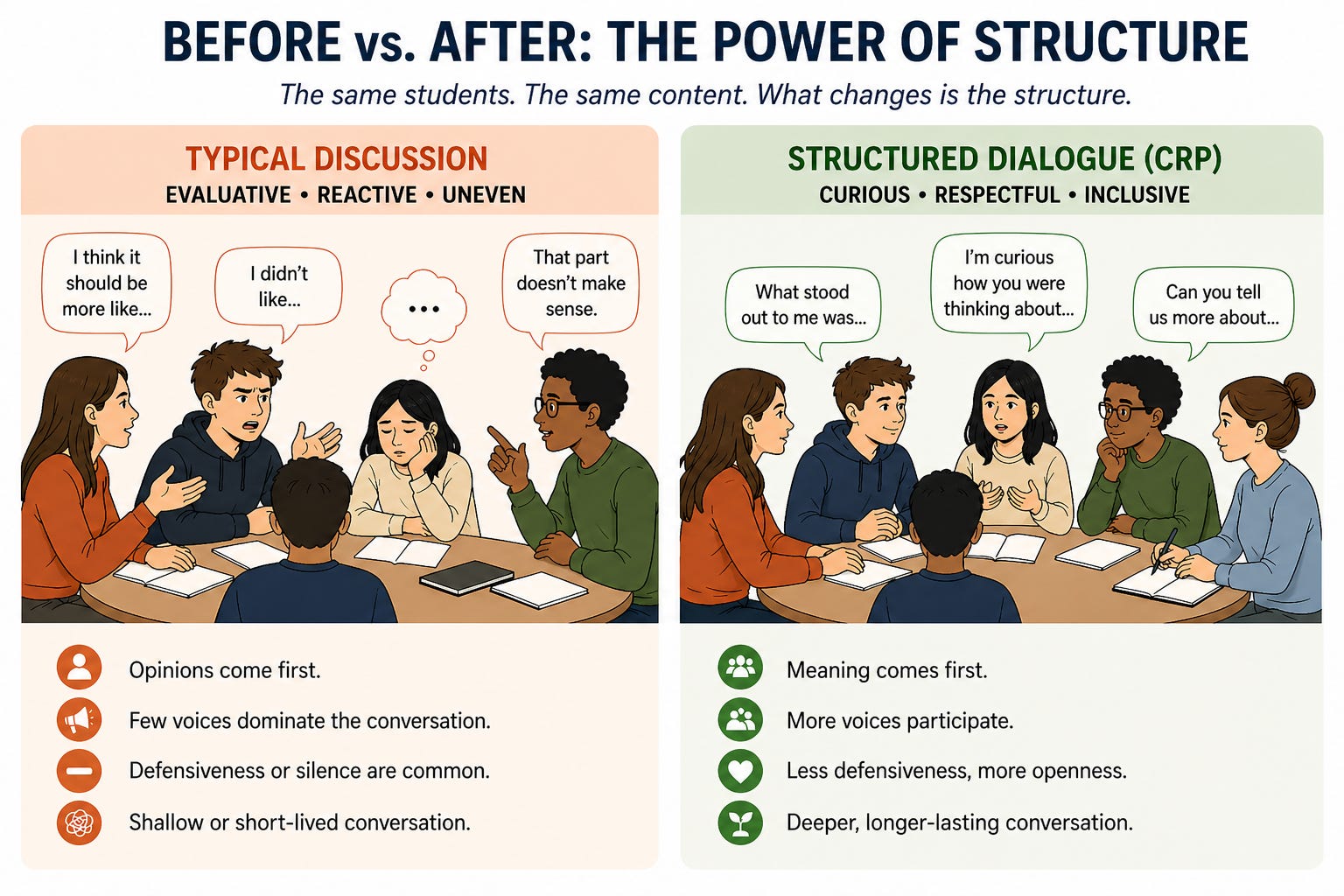
The first time I used the Critical Response Process (CRP) in one of my college classes, I wasn’t sure it would land.
Liz Lerman developed it from 1990 onward in arts settings — a structured way of moving through feedback that she’d refined with dancers, theater makers, visual artists, and community groups (Lerman & Borstel, 2003). I’d learned it directly from her, and I believed in it. But I also knew that what works in an art studio doesn’t automatically transfer to a classroom. Students have their own rhythms. Their own defenses. Their own histories with being told their work isn’t quite right.
So I held my breath a little.
By the third session, I’d stopped worrying.
More students were speaking up — not just the ones who always did. The questions people asked each other were more precise, more genuinely curious. And the tone in the room had shifted in a way I found hard to name at first. It wasn’t warmer, exactly. It was more steady. More focused. Like everyone had quietly agreed to take the conversation seriously.
Nothing about the content of the class had changed. Same material. Same students. Same me.
What had changed was the structure they were working inside.
And that, I’d come to realize, changes everything.
What We Leave Out
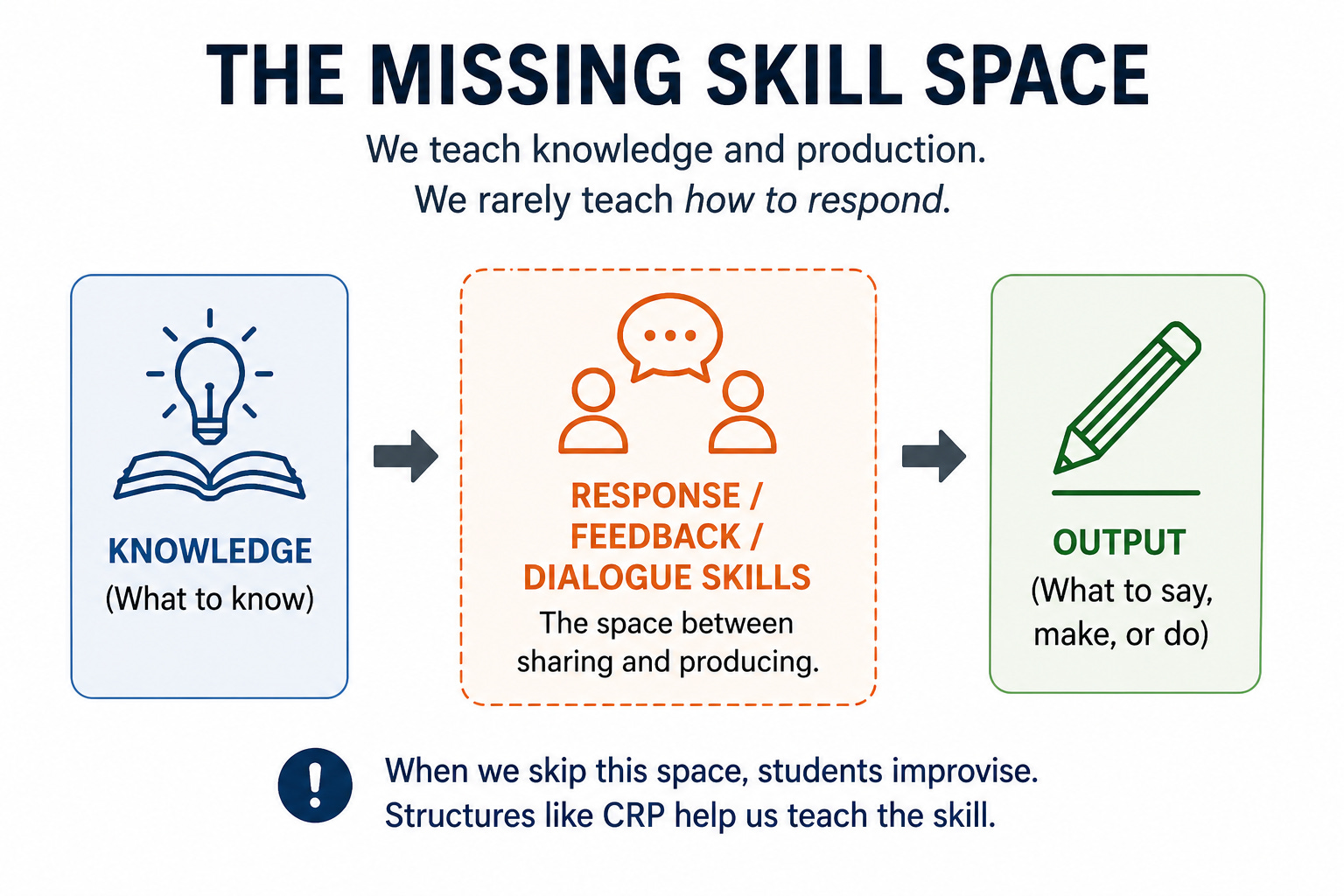
Most of what we teach in school is about what to know and what to produce.
We spend almost no time on what happens in the space between those two things — the moment when someone shares something they made, or said, or thought, and everyone else has to decide how to respond.
That moment is a skill. We just don’t treat it like one.
So students do what people always do when they haven’t been taught something: they improvise. They fall back on patterns they’ve picked up somewhere — quick opinions, surface observations, polite nods, or silence. Not because they’re disengaged. Often because they genuinely don’t know what else to do.
I’d watched this happen for years before I had a name for it.
What CRP Actually Does
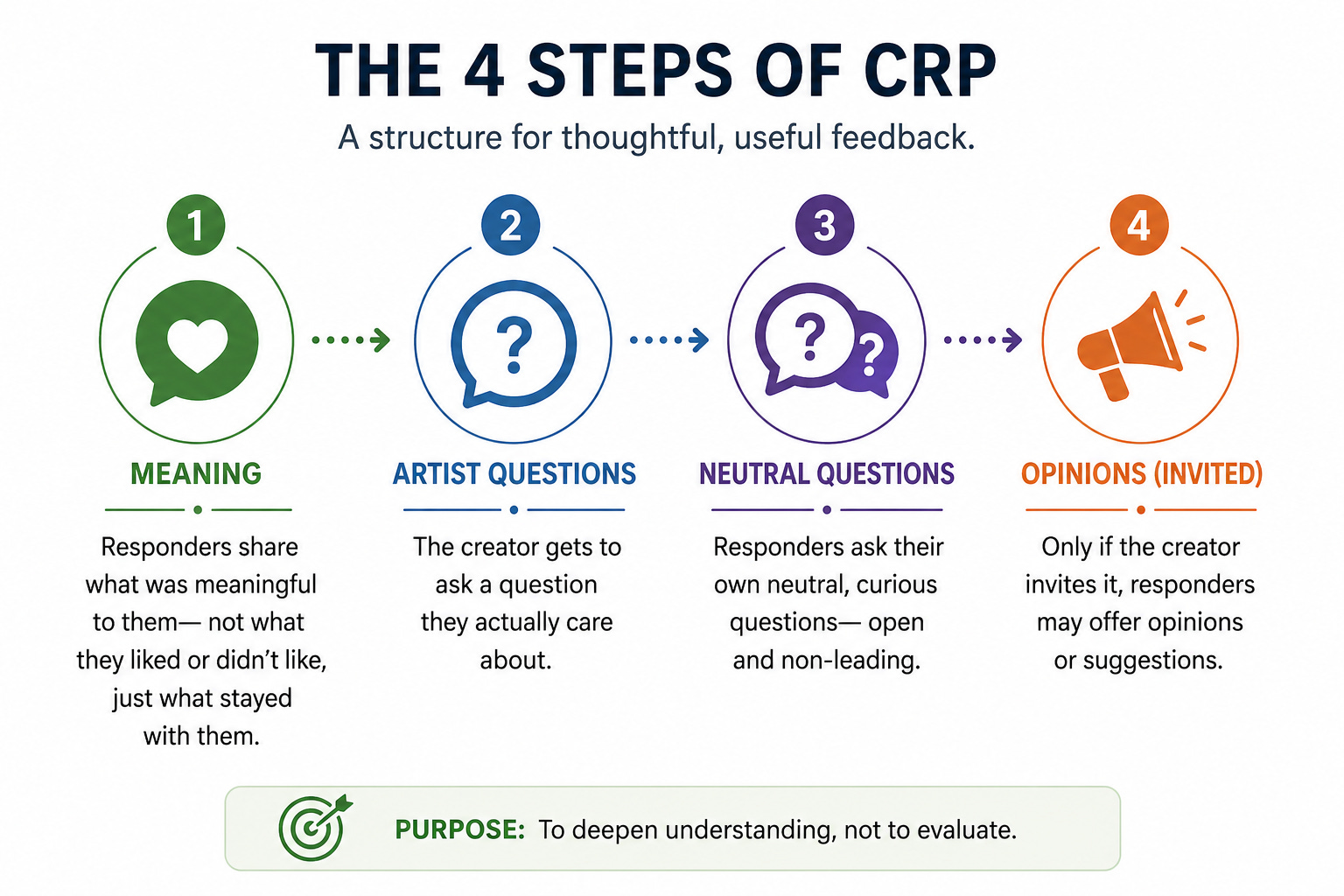
The Critical Response Process is structured in four steps (Lerman & Borstel, 2003):
First, responders share what was meaningful to them — not what they liked or didn’t like, just what stayed with them. Second, the person who made the work gets to ask a question they actually care about. Third, responders ask their own neutral questions — curious, open, not leading anywhere in particular. Fourth, and only if the creator invites it, opinions come in.
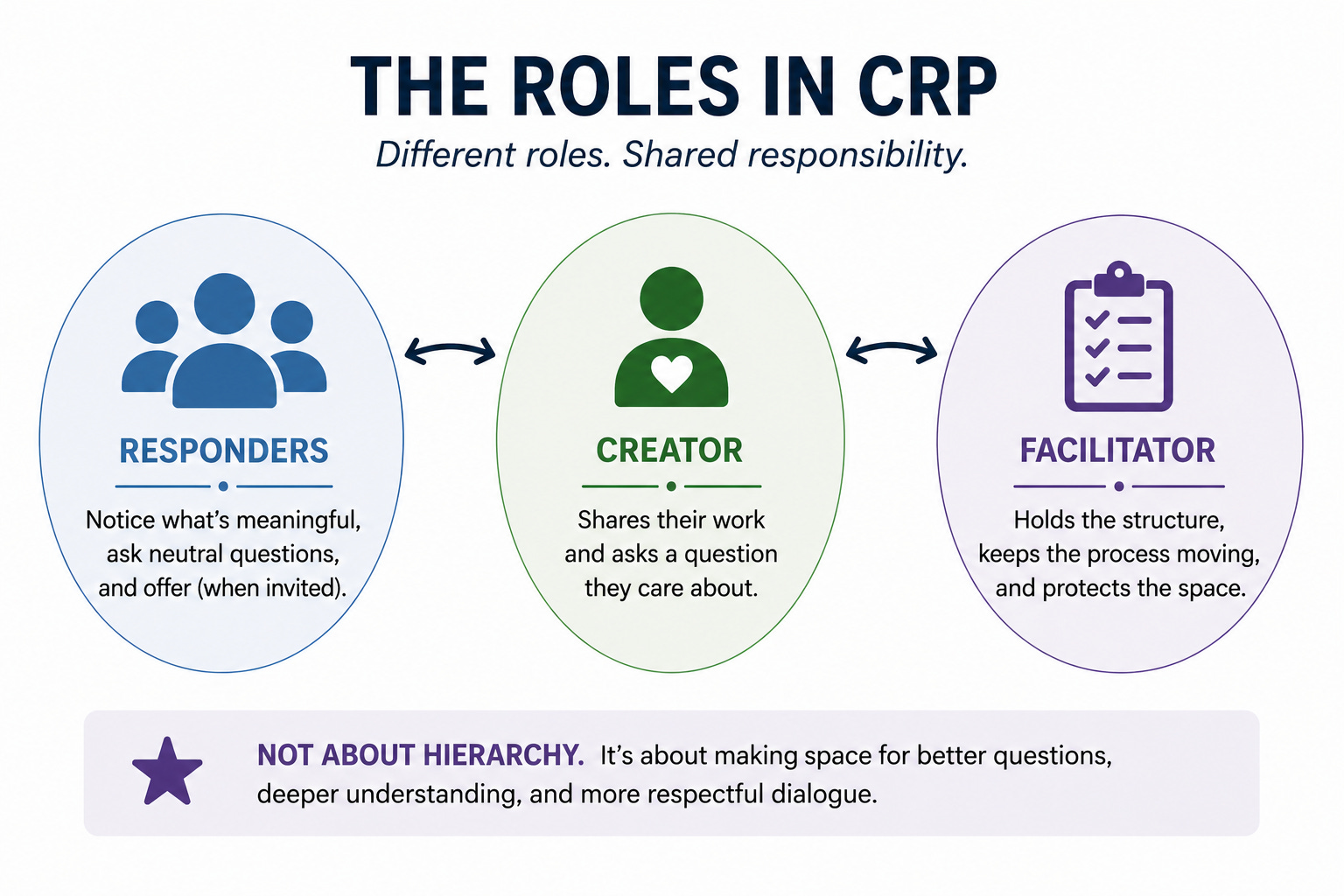
There are roles, too. The creator shares and asks. Responders notice, question, and offer within the structure. A facilitator holds the shape of the conversation so it doesn’t drift back into old habits.
At first glance, this can feel constraining. Students sometimes push against it. Why can’t I just say what I think?
But that constraint is the point.
When people know what’s expected — and what isn’t — they relax in a different way. They don’t have to compete for airtime or brace for something sharp. They don’t feel pressure to have the “right” answer on the spot or defend their thinking in real time. The structure holds some of that tension so they don’t have to.
In one class, a student shared a piece of music they’d clearly been nervous about. You could see it in the way they held the paper, the way they looked at the table instead of the room. In a typical discussion, someone would have jumped in with an opinion — probably a kind one, but still an evaluation. Instead, the first few responses were: What stood out to me was… and I’m curious how you were thinking about… Then the student asked a question they actually wanted answered.
The conversation that followed lasted longer than usual. More people spoke. And no one had to remind anyone to be respectful — it was just already happening.
I’ve thought about that session a lot since.
A Skill Gap, Not a Values Gap
I want to say something that might sound obvious but I think gets missed:
Most people aren’t bad at conversation because they don’t care. They’re bad at it because they were never shown how.
We talk a lot about listening, empathy, and respectful dialogue as values — things people should want to have. And most people do want them. But wanting something doesn’t mean you know how to do it, especially under pressure, especially when something feels personal.
What I’ve seen in classrooms, and increasingly in the world outside them, is that when disagreement escalates or conversations shut down, it’s usually not a values problem. It’s a skills problem. People don’t have the moves. They don’t know how to ask a question instead of firing back, or how to stay with discomfort without either shutting down or escalating.
Those moves are learnable. We just have to actually teach them.
Why This Is a Sustainability Problem
When sustainability researchers and educators talk about what K–12 teachers need to develop in their students, they don’t just mean content knowledge about climate or ecosystems. They mean competencies — ways of thinking and working together that make collective action possible.
Collaboration is central to almost every framework. So are systems thinking, the ability to sit with uncertainty, and the capacity to work across differences toward shared goals. UNESCO’s framework for Education for Sustainable Development identifies these as essential — eight key competencies, including collaboration, systems thinking, anticipatory thinking, and integrated problem-solving, that together describe not just what students should know, but how they should be able to work with others (UNESCO, 2017). Sustainability isn’t just a set of problems to solve; it’s a way of being in relation to others while you try to solve them.
These competencies don’t develop on their own. They need to be practiced — which means teachers need structures that make the practice possible inside the rhythms of a real classroom, not just in theory.
That’s where structured dialogue comes in.
Not dialogue in the narrow sense of “taking turns talking” — but in the fuller sense of how students actually respond to each other, how they handle disagreement, whether the process holds when things get hard. That ongoing responsiveness is the connective tissue of any group trying to work on something that matters. Without it, collaboration becomes performance. Systems thinking stays abstract. The capacity to work across differences collapses into either conflict or silence.
Music classrooms are actually a particularly natural home for this kind of work. Creative subjects already ask students to share something they made and have others respond to it — which means the conditions for practicing structured dialogue are already present. Music teachers can use CRP not just to improve how students talk about each other’s work, but to explicitly teach the interpersonal and collaborative competencies that ESD frameworks identify as essential (Lerman & Borstel, 2003; UNESCO, 2017). And because those moves are practiced in a low-stakes, creative context, they become easier to carry into harder conversations elsewhere.
But music classrooms are just one entry point. The same capacity matters across every subject and every grade level — anywhere students have to work together across different perspectives on problems without easy answers.
If students can’t respond to each other in ways that keep the process alive, the sustainability competencies we care about remain theoretical. Good intentions don’t fill that gap. Shared structure does.
Where to Start
You don’t need to introduce the full process on day one. You don’t even need to call it anything.
Try this: after someone shares work, before anyone responds, ask the room — What stood out to you as meaningful? Let a few people answer. Then ask the creator: What’s a question you have about your own work? Take a few neutral questions. Stop there.
That’s it. That’s enough to feel the difference.
Or, even simpler: the next time a student brings you a problem and you’re about to jump in with advice, pause and ask first — Would you like to hear an opinion? It’s a small move. But it changes what happens next.
What I Was Actually Teaching
When I look back at those early sessions with CRP, what strikes me now is how much was happening beneath the surface.
Students weren’t just learning to give better feedback. They were learning how to stay in a shared process — how to listen without already forming their response, how to ask a question without having an agenda, how to be uncertain in public without it feeling like a threat.
They were learning, in other words, how to work with other people.
I used to think of that as a byproduct of good teaching. Now I think it might be the thing itself.
You don’t need a new curriculum to start this. You don’t need to overhaul your practice or master every ESD framework before you begin. You just need one structured moment — one question asked before the opinions rush in — and the willingness to try it again tomorrow.
That’s enough to start.
References
Lerman, L. (2026). Critical response process: A method for giving and getting feedback. Liz Lerman’s Critical Response Process. https://lizlerman.com/critical-response-process/
Lerman, L., & Borstel, J. (2003). Liz Lerman’s critical response process: A method for getting useful feedback on anything you make, from dance to dessert. Liz Lerman Dance Exchange.
UNESCO. (2017). Education for sustainable development goals: Learning objectives. UNESCO. https://doi.org/10.54675/CGBA9153