
Why Music Educators Need to Know About the SDGs
And why I’m starting with number four

A reader wrote to me recently with a simple request:
“I would like to understand better the 2030 Sustainable Development Goals and how those goals can be tied back to education.”
It struck me, because I realized I had spent months writing around the Sustainable Development Goals without ever really introducing them. I had assumed people knew what they were. Most don’t — and honestly, I didn’t either for much of my teaching career.
Like many educators, I had seen the colorful icons. They showed up on conference slides, posters, websites, and the occasional professional development packet. But seeing them and understanding them are two very different things. No one ever sat me down and explained what they were, how they fit together, or why they might matter to someone teaching music. I had to go looking on my own. This is the explanation I wish someone had handed me years ago.
In 2015, all 193 member states of the United Nations agreed to seventeen Sustainable Development Goals, commonly called the SDGs. Together they describe what a better future might look like: ending extreme poverty, improving health, expanding access to education, advancing gender equality, protecting ecosystems, addressing climate change, strengthening peaceful societies. They are not laws and they are not mandates. They are a shared framework for thinking about the future we say we want to build.
But to understand the SDGs, it helps to see where they sit inside a much larger picture.
Sustainability, sustainable development, the SDGs, and ESD
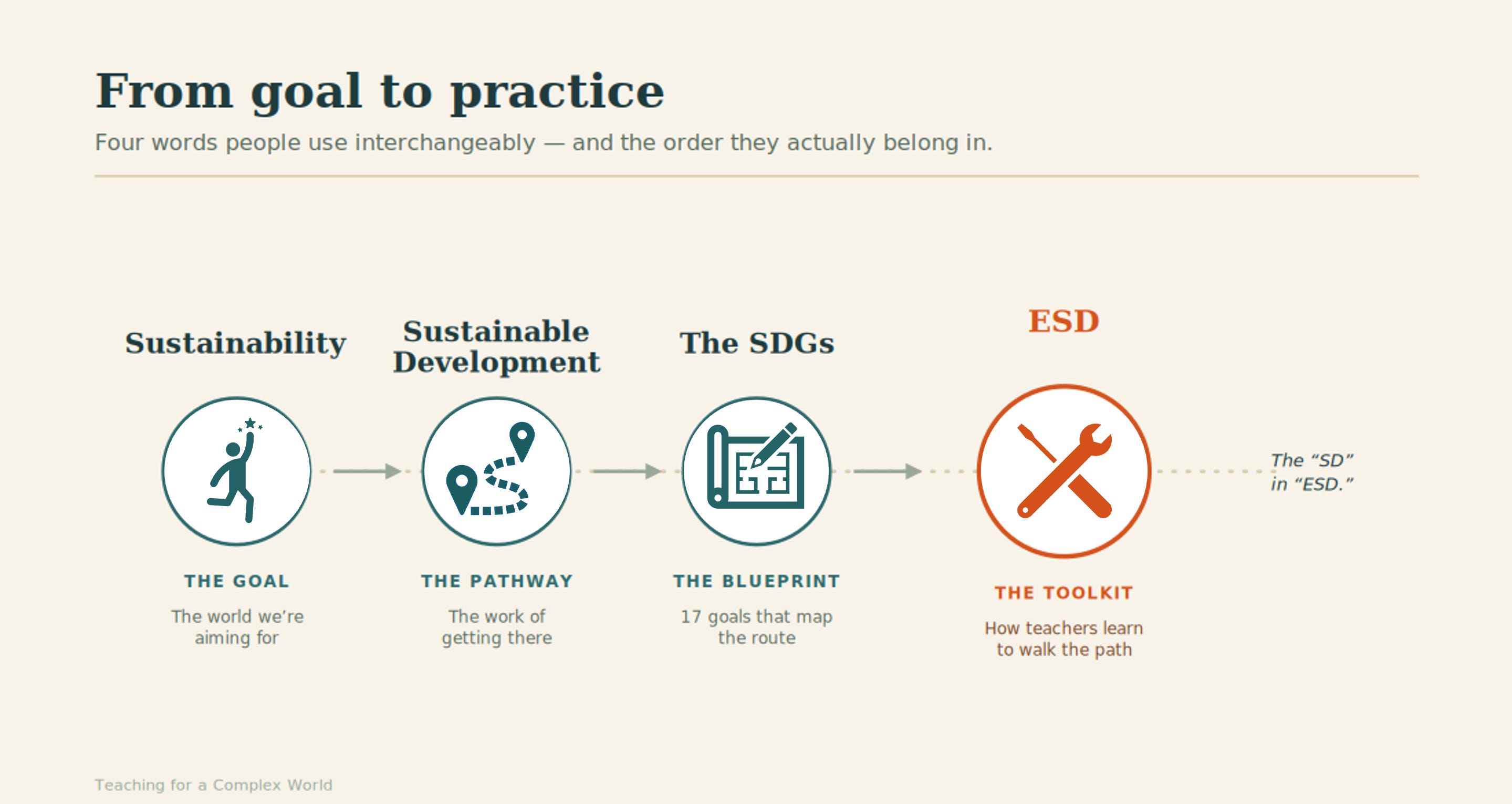
These four terms are closely related, but they are not the same thing.
Sustainability is the goal. It describes a condition in which environmental health, social well-being, and economic prosperity can hold together over time. It answers the question: what are we ultimately trying to achieve?
Sustainable development is the pathway. It refers to the decisions, policies, and actions that move societies toward that destination. It answers: how do we get there?
The SDGs are the blueprint. The seventeen goals — and the 169 targets beneath them — lay out a shared picture of what progress looks like, identifying the major challenges humanity has to address to move toward a more sustainable future.
Education for Sustainable Development (ESD) is the toolkit. It is the teaching and learning that helps people understand complex challenges, imagine alternative futures, and develop the knowledge, skills, values, and dispositions needed to help create them.
Notice the name. The SDGs are the “SD” in “ESD.” The education is for sustainable development. So sustainability is the destination, sustainable development is the journey, the SDGs are the map, and ESD is how we learn to read it.
And because the goals are interconnected, you cannot meaningfully solve one by ignoring the others. Progress in education affects health. Health affects poverty. Poverty affects environmental outcomes. Those outcomes affect everything else. That interconnectedness matters more than it first appears — which is exactly why knowing the goals, and choosing to work toward them, is not a passive act. The framework only has force if enough people understand it well enough to defend it.
The honest part about 2030
The numbers are what they are.
Globally, only about 17% of SDG targets are on track, and more than a third have stalled or are sliding backward, according to the UN’s Sustainable Development Goals Report 2024. Progress on many measures slowed during the pandemic and has been further strained by conflict, displacement, economic instability, and mounting environmental pressure. The education figures alone are hard to sit with: UNESCO’s 2024 Global Education Monitoring Report finds that 251 million children and young people remain out of school worldwide, more than half of them in sub-Saharan Africa — a number that has fallen by only about 1% in nearly a decade. The annual funding gap for lower-income countries to reach their education targets runs to roughly $97 billion, and the world is short some 44 million teachers. The deadline is now less than five years away.
But the numbers don’t capture everything working against the goals, because education is among the first casualties of the forces reshaping global politics right now. Wars displace children and turn schools into rubble or shelter. In some countries, girls have been barred from classrooms outright — a political decision about who is permitted to learn at all. Disinformation erodes the shared facts that education depends on, turning subjects like climate science into a battleground rather than a body of knowledge to be taught. When rights contract, education contracts with them. None of this is incidental to SDG 4. It is the headwind the goal is now moving against, and it is why understanding the goals is not the same as assuming someone else will protect them.
So what do you do when you know you will miss a deadline? One response is to scale back the ambition — to quietly lower expectations. A group of researchers writing in Nature in 2024 argued for the opposite. Because the challenges the SDGs represent are so deeply interconnected, addressing fewer of them doesn’t actually make the problem smaller; it just leaves the hardest knots untouched. Their proposal was to extend the framework to 2050, with major checkpoints along the way.
I find that persuasive. The year 2030 was never really a finish line — it is a progress report. The point was never to “complete” sustainability by a particular date, but to begin building the habits, institutions, and systems capable of supporting a more sustainable future over generations. Urgency is real, and systems change is slow. Both are true at the same time, and one does not cancel out the other.
So why is a music teacher writing about this?
Some of the connections are obvious. SDG 4, Quality Education, belongs to every educator by definition, and SDG 4.7 — which explicitly names cultural diversity and sustainability — feels especially close to music education. Others take more work to see: the link between community music and peacebuilding, say, or between learning another culture’s music and understanding sustainability, or between composing a piece and the act of imagining a future that doesn’t yet exist. Those connections need more explanation, and I’ll build them over the course of this series.
But the reason I’m writing it is simpler than any single goal. If you teach music — in a classroom, a studio, a rehearsal hall, or a university methods course — you spend your days in sustained contact with the next generation. You help shape how people learn to listen, collaborate, express themselves, and take part in communities larger than themselves. That matters. Not because music teachers are uniquely virtuous, and not because the arts can solve every problem, but because every one of the goals ultimately depends on people learning how to live together — and education is where much of that learning happens.
For everyone who teaches
Education is the lever that helps the other goals move. It reduces poverty, improves health outcomes, supports gender equality, strengthens democratic participation, and contributes to more peaceful and resilient societies. This isn’t merely an inspirational claim; it’s one of the core assumptions built into the SDG framework itself. The United Nations describes SDG 4 as having a catalytic effect across the whole agenda, because progress in education tends to pull progress along elsewhere.
Which is sobering, because roughly two-thirds of countries with available data have made little or no progress toward their education targets. Millions of children remain out of school, and many who are enrolled struggle to reach basic literacy benchmarks. For educators, none of this is abstract. It shows up as overcrowded classrooms, shrinking budgets, staffing shortages, and programs that vanish the moment funding dries up. The battles teachers fight locally are not separate from these global challenges — they are the same challenges seen at a different scale.
For music teachers in particular
SDG 4.7 is a target most people never notice. It commits the international community to education that promotes global citizenship, cultural understanding, and an appreciation of cultural diversity — including, in its own words, an appreciation of “culture’s contribution to sustainable development.”
That language matters, because it means culture is not an optional decoration at the edges of education. It is part of how a quality education is defined. When music teachers introduce students to traditions beyond their own, they aren’t merely adding variety; when they help students understand how music carries history, identity, community, and place, they are doing exactly the kind of learning SDG 4.7 calls for.
There is also a more practical argument. Music programs are often among the first things cut in under-resourced schools, especially those serving low-income communities. Yet the evidence consistently points the same direction: access to music education is associated with stronger attendance, higher graduation rates, deeper engagement, and real social-emotional benefits. The point isn’t that music education alone solves educational inequality. It’s that when these programs disappear, something valuable disappears with them — and the loss reaches well past music itself.
The harder half: developing our ESD skills
Everything I’ve written so far is the comfortable half of the argument. It’s reassuring to notice the places where music education already overlaps with the SDGs. But that’s only half the story.
Music teachers spend years developing their musical chops. We study repertoire, learn rehearsal strategies, refine our conducting and assessment, and work hard at the craft of teaching. Education for Sustainable Development deserves the same seriousness. Sensing that music already brushes up against these ideas does not automatically make someone skilled at teaching them. Understanding that cultural diversity matters does not automatically prepare someone to facilitate honest conversations about sustainability, equity, uncertainty, or the future.
ESD is its own craft. Systems thinking is a skill. Futures thinking is a skill. Helping students navigate complexity, disagreement, and collective action is a skill. All of them can be learned — and most of us were never formally trained in any of them. I certainly wasn’t. Much of what I know about ESD came from following citations, reading reports, attending conferences, and feeling lost more often than I care to admit.
And this isn’t simply an individual challenge; it’s a structural one. Many curricula still devote little attention to sustainability education, climate change remains absent from large stretches of secondary schooling worldwide, and teacher preparation programs vary widely in whether they address sustainability at all. So if we believe sustainability matters, developing this fluency can’t stop at lesson design. It also means tending to the conditions that make the work possible in the first place — curricula, teacher preparation, funding, public policy. The lesson plan and the policy are the same project seen at different scales.
Music teachers need to build this capacity. So do educators generally, and so does anyone who cares about the place where education and sustainability meet. I’m still building mine. That’s part of why I’m writing this series at all.
Beneath the surface
Look closely at what music educators do, and many of the goals are already in the room.
At the surface, it looks like teaching students to play. Beneath that, it’s teaching them how to make choices when there’s no single right answer — how to interpret, revise, and decide, then sit with the result and try again. That is the kind of judgment every complex problem eventually demands.
Beneath that, it becomes a question of access and equity. Who can afford an instrument? Whose musical traditions get treated as central, and whose as enrichment? Whose programs are protected when budgets shrink? Those aren’t merely musical questions. They are questions about opportunity, participation, and belonging.
And underneath all of it is something music uniquely offers: it helps people connect, imagine, grieve, celebrate, and hope. Set against the scale of the challenges the SDGs describe, those capacities are not decorative — they are structural. Composition is future-oriented thinking. Community music is democratic rehearsal. Music educators have been doing versions of sustainability education for a very long time. The challenge now is to do it more intentionally, more thoughtfully, and more skillfully.
Why I’m starting with number four
Goal 4 is Quality Education. It’s home base — the goal most directly tied to what educators do every day, and the one many researchers consider foundational to progress across the rest of the framework.
But it also raises questions that are harder than they first appear. What counts as a quality education? Who gets access to it? Who decides what is worth teaching? What does a school owe the young people it is preparing for a future they will inherit? Before we talk about poverty, health, climate change, gender equality, or peace, it’s worth sitting with those questions first.
Because if education really is the goal that helps the others move, then the question beneath SDG 4 isn’t simply how we teach. It is what kind of future we are teaching toward.
This series began because a reader asked a question, and I’m grateful they did. If there’s an SDG you’d like me to reach sooner, or a connection you think I’m missing, let me know. Those conversations genuinely shape what comes next.
Next: SDG 4 — Quality Education. What does it actually mean to teach music well, and who gets to decide?
If any of this resonated — or if you think I am getting something wrong — I would genuinely like to hear from you in the comments. And if there is a topic you would like me to dig into — something that has been sitting with you, something you cannot quite find good writing on — please reach out. That kind of signal genuinely shapes what I write next.
If you are finding value here, subscribing — even at the free level — helps this work reach more people. So does liking, commenting, and reposting. In a crowded information environment, those small actions matter more than most people realize. I notice every one of them, and I am sincerely grateful for each.
Thank you for reading. It means more than I can easily say.
I am an independent scholar with a PhD in education, writing about sustainability, Education for Sustainable Development, and the future of learning. I am available for research collaboration, consulting, and teaching opportunities — linkedin.com/in/kylecbartlett
Sources
United Nations. (2024). The Sustainable Development Goals Report 2024. (17% of targets on track; over one-third stalled or regressing.)
UNESCO. (2024). Global Education Monitoring Report 2024: Monitoring SDG 4. (251 million children and youth out of school; ~1% decline in nearly a decade; over half in sub-Saharan Africa.)
UNESCO & World Bank. (2024). Education Finance Watch 2024. (≈$97 billion annual funding gap for low- and lower-middle-income countries.)
UNESCO. (2024). Transforming Education Towards SDG 4. (≈44 million teacher shortage worldwide.)
Fuso Nerini, F., et al. (2024). Extending the Sustainable Development Goals to 2050 — a road map. Nature, 630, 555–562.
Great start Kyle on breaking down the SDG into understandable pieces and a focus on SDG 4.7. The breakdown of a the SDG into pathway, blueprint and education well stated and understandable. And yes Education is the lever that can potentially be a positive catalyst for the overall SDG goals. Looking forward to the continued series.
Excellent!!